 English
  Русский
Blue vs red threadlocker: how to choose, apply and undo it
Updated:
Choosing blue or red threadlocker comes down to one question: will you need to take the joint apart later? Blue is a medium-strength, removable threadlocker: it stops nuts and bolts working loose, yet the joint comes apart with ordinary tools. Red is high-strength and permanent: it is used where a joint is dismantled only during a major overhaul, and to undo such a bolt the joint is heated to 150–200 °C.
What you need
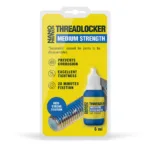
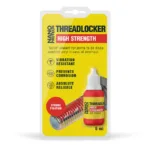
Blue vs red threadlocker: the differences
- Locking strength. Breakaway torque is no more than 17 N·m for blue and no more than 35 N·m for red.
- Dismantling. Blue threadlocker comes undone with ordinary tools; red threadlocker is heated to 150–200 °C first.
- Purpose. Blue is for joints that are adjusted and taken apart. Red is for joints dismantled only during a major overhaul; it withstands heavy shock loads and extreme chemical activity.
- What they have in common. Both are for metal threads up to M20 (not for plastic). They seal the thread, make the joint resistant to vibration and prevent corrosion. Both cure without air in gaps of up to 0.4 mm and work at −60 °C to +150 °C.
If you are unsure which to choose, ask whether you will undo this bolt during routine maintenance. If yes, choose blue (removable): it suits metal fasteners on bicycles, e-scooters, motorbikes and furniture, as well as small M2–M6 screws. If the joint should stay put until a major overhaul, choose red (permanent), for example for studs and threaded inserts in sound threads, provided the assembly gets no hotter than +150 °C.
How to use threadlocker: step by step
- Choose the threadlocker. For joints you will adjust and dismantle, take the blue Medium-strength threadlocker; for those dismantled only during a major overhaul, the red High-strength threadlocker.
- Check the temperature. Apply threadlocker at +10 °C to +45 °C.
- Prepare the thread. Clean off rust, dirt and oil, degrease with acetone or petrol and let the thread dry. Repair a stripped thread first — threadlocker does not replace it.
- Apply the compound. Spread it over the whole thread profile by running the nut up and down the coated section, then tighten the joint. A drop is enough for small screws; wipe off the excess.
- Let it cure. Blue fixes the joint in 20 minutes. Curing takes 2 hours, and final strength comes after 24 hours at +18 °C or above — only then put the joint under full load.
- Dismantle correctly. Undo blue threadlocker with ordinary tools. For red, and for any joint with a thread larger than M20 or one that cannot take considerable force, heat the joint to 150–200 °C with a heat gun or blowlamp, then take it apart.
Why it may not work
- The threadlocker did not set. It cures only without air, in a thread gap of up to 0.4 mm. A drop on an open surface and any excess outside the joint stay liquid, so testing threadlocker in the open air is pointless.
- The gap is too large. A worn or stripped thread or a loose fitting has a gap of more than 0.4 mm: the compound will not cure or seal there. Replace the fastener or fitting, or repair the thread.
- The thread was not degreased, or the metal is passive. Oil and dirt interfere with curing, so always degrease the thread. On stainless steel, aluminium, silumin and galvanised fasteners the compound cures more slowly.
Safety precautions
- If threadlocker gets into the eyes or onto the skin, rinse with water. If swallowed, rinse the mouth with water and see a doctor.
- When heating a joint, remove anything flammable nearby and do not heat assemblies close to the battery, wiring, fuel system, plastic or rubber.
- Treat brakes, wheel hubs, wheel fasteners and steering with threadlocker only if the vehicle manufacturer's instructions require it. Do not use it to seal brake, gas equipment or air conditioning lines.
- Store threadlockers in a dry, dark place at no more than +35 °C, out of the reach of children. The shelf life is 24 months from the date of manufacture.
Frequently asked questions
How do I undo a bolt secured with red threadlocker?
Heat the joint to 150–200 °C with a heat gun or blowlamp, then take it apart. If rust rather than threadlocker is holding the bolt, see how to remove a seized bolt.
How long does threadlocker take to cure?
24 hours to final strength, at +18 °C or above. Curing takes 2 hours, and blue fixes the joint after just 20 minutes. Threadlocker does not dry in air: it cures only inside the thread, where air cannot reach.
Which threadlocker should I use on a bicycle or e-scooter?
Blue: it is used on metal fasteners that loosen from vibration and are removed from time to time for adjustment. Red is not used on e-scooters — it has to be heated for dismantling, and the battery and wiring are nearby.
More solutions
- Heated rear window not working: how to find a broken line and repair it
- How to use epoxy putty (cold weld): preparation, mixing, application, storage
- How to fix a leaking pipe with epoxy putty: metal pipes, taps and radiators
- How to fix a fuel tank or radiator leak: a temporary repair with epoxy putty
- How to glue glass: clear UV glue, light and step-by-step instructions
- How to fix remote control buttons: restoring contacts with conductive glue
Still have questions?
Describe your task and a NANOPROTECH technical specialist will suggest the right product and how to use it.