 English
 Русский
How to fix a cracked toilet, cistern or sink yourself
Updated:
You can fix a cracked toilet, cistern or sink with cold weld for sanitary ware, a two-component epoxy putty for ceramics and faience. Clean the repair area, rough it up with coarse sandpaper, degrease and dry it, then press the kneaded putty into the crack; after 2.5 hours the joint can be sanded, loaded and painted. Shut off any leak under pressure first.
What you need
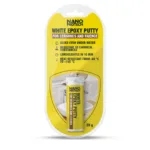
When you can repair a crack yourself
Cold weld for ceramics and faience repairs chips, cracks and missing fragments of toilets, cisterns, sinks, kitchen sinks, baths, shower trays and tiles, and seals joints in sanitary ware. The cured putty resists temperature changes and chemical reagents and withstands −60 °C to +150 °C. If the crack runs through the whole bowl or the mounting and the toilet wobbles, the repair is temporary and the toilet should be replaced. Do not glue a toilet to the floor with the putty: use its standard fixings.
How to fix a cracked toilet — step by step
- Turn off the water and drain the area. Shut off the supply, empty the cistern and remove the water from the bowl or sink below the crack. The putty bonds even on a wet surface, but a leak under pressure washes it out before it cures.
- Prepare the surface. Clean off dirt and deposits, rough up the edges of the crack with coarse sandpaper, degrease and dry. The strength of the repair depends on preparation.
- Cut off and knead the putty. Cut at least 1/3 of the stick of NANOPROTECH Epoxy putty for ceramics and faience right across: in a smaller piece the ratio of components is off. Wearing gloves, knead it with your fingers, which you can wet, until the colour is uniform.
- Fill the crack. Straight after mixing, while the putty is pliable, press it into the crack with a small margin over the edges. On a damp surface, keep smoothing it until it grips.
- Bond a broken-off piece. Apply the putty to both surfaces, press them together and hold them for 15 minutes.
- Smooth the seam. Shape it with a flat object moistened with water and remove the excess before the putty hardens.
- Wait for it to cure and check the repair. After 2.5 hours the seam can be sanded, loaded and painted if needed. Then turn the water back on, fill the cistern and check for drips.
Why it may not work
- The putty came away. Usually the surface was not roughened or degreased: on oily surfaces the bond strength is 20% lower.
- The putty did not reach full strength. The piece was too small or unevenly mixed. Cut at least 1/3 of the stick right across and knead until the colour is uniform.
- The stick has hardened in the pack. This happens after storage or sharp temperature changes. Warm it to +60 °C for about 10 minutes, in hot water or on a radiator, and the putty becomes pliable again.
- The seam is a different colour. The putty is light-coloured but not pure white. To match the sanitary ware, sand and paint the seam after 2.5 hours.
Safety precautions
- Wear gloves and keep the putty out of your eyes. If it gets into them, rinse with water and seek medical advice.
- Do not apply the putty to surfaces that come into contact with food.
- Store the stick in a dry, dark place at no more than +35 °C, out of the reach of children. The shelf life is 18 months.
Frequently asked questions
What can I use to fix a cracked toilet?
Cold weld for sanitary ware. Clean, sand, degrease and dry the repair area, cut off at least 1/3 of the stick, knead the putty to a uniform colour and press it into the crack. The repair can take load after 2.5 hours.
Can a crack in a toilet cistern be repaired?
Yes. Turn off the water, empty the cistern, sand, degrease and dry the cracked area and fill the crack with the putty. The cistern can be refilled after 2.5 hours.
Can I fix a crack while water is leaking?
Not under pressure. The putty bonds even under water if you keep smoothing it until it grips, but a pressurised leak washes it out before it cures, so turn the water off.
How do I glue a broken-off piece of ceramic?
With epoxy putty for ceramics and faience: apply it to both surfaces, press them together and hold for 15 minutes. The joint can take load after 2.5 hours. Surfaces that come into contact with food are not repaired this way.
Will the repair withstand hot water?
Yes. The cured putty withstands −60 °C to +150 °C and resists chemical reagents, so hot water and household cleaning products will not harm the repair.
More solutions
- Heated rear window not working: how to find a broken line and repair it
- How to use epoxy putty (cold weld): preparation, mixing, application, storage
- Blue vs red threadlocker: how to choose, apply and undo it
- How to fix a leaking pipe with epoxy putty: metal pipes, taps and radiators
- How to fix a fuel tank or radiator leak: a temporary repair with epoxy putty
- How to glue glass: clear UV glue, light and step-by-step instructions
Still have questions?
Describe your task and a NANOPROTECH technical specialist will suggest the right product and how to use it.