 English
 Русский
How to glue plastic: which glue to use and how to make it hold
Updated:
To glue plastic, use a two-component epoxy: a clear epoxy glue gives a thin, colourless, elastic seam, while multipurpose epoxy putty (cold weld) fills cracks, chips and missing fragments. Clean the surfaces, always rough them up with coarse sandpaper, then degrease and dry them: this decides whether the joint will hold. Polyethylene and polypropylene (marked PE and PP) hold epoxy compounds poorly.
What you need
Which glue to choose for plastic
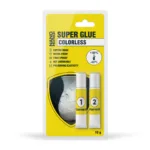
- Clear epoxy glue — for joining parts with a thin, colourless seam: plastic and PVC, toys, fittings, parts of household appliances and cars, plastic to metal, wood or glass. Once cured, the seam stays elastic, does not shrink and withstands water, frost and vibration.
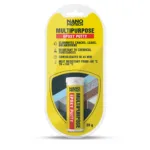
- Multipurpose epoxy putty — a plasticine-like epoxy compound for cracks, holes and missing fragments, and for joining plastic to metal. You shape it in place, and once cured it can be drilled, sanded and painted.
Look for the plastic marking on the part itself: letters or numbers inside a triangle. If it says PE or PP, epoxy glue will not hold.
How to glue plastic — step by step
- Check what plastic it is. Polyethylene and polypropylene (PE and PP) hold epoxy compounds poorly; for other plastics they are suitable.
- Prepare the surfaces. Clean off dust and oil stains, always rough the surfaces up with coarse sandpaper, degrease them and let them air-dry for 15–20 minutes. Test the solvent on an inconspicuous area first: some plastics turn cloudy.
- Mix the clear glue. Squeeze equal amounts from both bottles of NANOPROTECH Super glue colorless onto a dry, clean plastic or wooden surface and mix thoroughly until uniform. The mix stays workable for 1–1.5 hours at +20 °C.
- Or knead the epoxy putty. Cut at least 1/3 off the stick of Multipurpose epoxy putty across its whole cross-section and knead it with your fingers, wet if you like, until the colour is uniform.
- Apply and hold. Apply the compound to both surfaces and press the parts together. Keep glued parts fixed for 2–3 hours, and parts joined with the putty for 15 minutes. Fill a crack or chip with the putty and shape it with a flat object moistened with water.
- Wait for full strength. A glued joint can be loaded and machined after 24 hours. The putty sets in 45 minutes, and after 2.5 hours the repair can be drilled, sanded, painted and loaded.
Why it may not work
- The seam came away from the part. It may be polyethylene or polypropylene, which hold epoxy compounds poorly. Another cause is a surface that was not sanded and degreased: on an oily surface the bond strength of the putty is 20% lower.
- The glue did not reach full strength. The components were not mixed in equal parts or not until uniform, or the joint was loaded before 24 hours had passed.
- The mix thickened too soon. Mix just enough glue for the current repair: the mix stays workable for 1–1.5 hours at +20 °C.
- The putty hardened in the pack. Warm the stick to +60 °C for about 10 minutes, in hot water or on a radiator, and it becomes pliable again.
Safety precautions
- Keep the compounds out of your eyes. If they get in, rinse with running water and seek medical advice if necessary. Wear gloves, and wash your hands with warm soapy water after work.
- Do not use epoxy compounds to repair dishes or other surfaces that come into contact with food.
- Keep the products out of the reach of children.
Frequently asked questions
How do I glue plastic to plastic so it holds?
With a two-component epoxy, after roughing the surfaces up with coarse sandpaper and degreasing them. Clear epoxy glue gives a thin, elastic seam; epoxy putty fills cracks and chips. Polyethylene and polypropylene cannot be glued this way.
Can polyethylene and polypropylene be glued?
No. Plastics marked PE and PP hold epoxy compounds poorly. Look for the marking on the part itself: letters or numbers inside a triangle.
What should I use to glue plastic to metal?
Multipurpose epoxy putty: it joins plastic to metal and fills gaps. For a thin, colourless seam, clear epoxy glue works: it bonds plastic, metal, wood, glass, rubber and leather.
How long does plastic glue take to dry?
Clear epoxy glue cures in 2–3 hours at +20 °C, and the parts are held fixed during that time; the joint can take load after 24 hours. Epoxy putty sets in 45 minutes and takes load after 2.5 hours.
Will the seam withstand water and frost?
Yes. The seam of clear epoxy glue is waterproof and frost-proof and withstands −60 °C to +150 °C; epoxy putty resists temperature changes and chemical reagents.
More solutions
- Heated rear window not working: how to find a broken line and repair it
- How to use epoxy putty (cold weld): preparation, mixing, application, storage
- Blue vs red threadlocker: how to choose, apply and undo it
- How to fix a leaking pipe with epoxy putty: metal pipes, taps and radiators
- How to fix a fuel tank or radiator leak: a temporary repair with epoxy putty
- How to glue glass: clear UV glue, light and step-by-step instructions
Still have questions?
Describe your task and a NANOPROTECH technical specialist will suggest the right product and how to use it.